
Warehouse Automation in Saudi Arabia (2026): How System Integration Connects Industrial Operations End-to-End
Warehouse and logistics operations in Saudi Arabia are undergoing significant transformation. Rising throughput demands, workforce constraints, and the complexity of multi-client fulfillment environments require operational approaches that manual processes and fragmented systems can no longer support reliably.
Warehouse automation addresses these challenges by connecting machinery, software, connectivity, and data systems into a unified operational infrastructure. At Manusphere, warehouse automation is delivered through an integrated approach that combines system integration, robotics, IoT connectivity, and industrial intelligence platforms.
What Is Warehouse Automation?
Warehouse automation refers to the deployment of technology systems, including robotics, sensors, connected networks, and software platforms, to manage, monitor, and optimize the movement of goods, assets, and personnel within warehouse and logistics environments. The objective is to replace or augment manual processes with systems that operate with greater consistency, accuracy, and data transparency.
Why System Integration Is Central to Warehouse Automation
Individual automation technologies deliver limited value when they operate in isolation. The full operational benefit of warehouse automation is realized when all systems communicate through a common integration layer.
System integration connects robotic platforms, IoT sensor networks, warehouse management systems, ERP platforms, and analytics interfaces into a single operational ecosystem. This integration ensures that data from each system contributes to a unified operational picture accessible to management in real time.
Autonomous Robotics in Warehouse Operations
Autonomous mobile robots and robotic forklifts are core components of modern warehouse automation. Robotic automation eliminates manual pallet transport and repetitive material handling, enabling continuous operation without downtime associated with shift changes or human fatigue.
Manusphere deploys logistical robots capable of carrying or towing loads up to 900kg without pre-mapping or Wi-Fi dependency. Robotic forklifts and jacks automate pallet transport with sensor-based navigation and collision avoidance, integrating directly with warehouse management platforms for task coordination.
IoT Connectivity as the Operational Foundation
Warehouse automation systems depend on reliable data transmission across the facility. Industrial IoT networks, including LoRaWAN® gateways for low-power sensor connectivity and Wi-Fi 6 infrastructure for high-bandwidth robotic and video applications, form the connectivity backbone that enables all automated systems to operate and report in real time.
Industrial Networking for Warehouse Environments
Warehouse environments present specific networking challenges: large floor areas, dense metal racking, electromagnetic interference from machinery, and high device density. Industrial networking solutions are designed to address these conditions, providing reliable connectivity for sensors, robotics, tracking systems, and management platforms across full warehouse footprints.
Digital Platforms for Operational Visibility
Operational data generated by warehouse automation systems reaches management through digital platforms that consolidate performance metrics, inventory status, equipment utilization, and safety data into real-time dashboards. These platforms enable management to monitor warehouse performance and identify operational inefficiencies without waiting for end-of-day reporting cycles.
Safety Systems Within Automated Warehouses
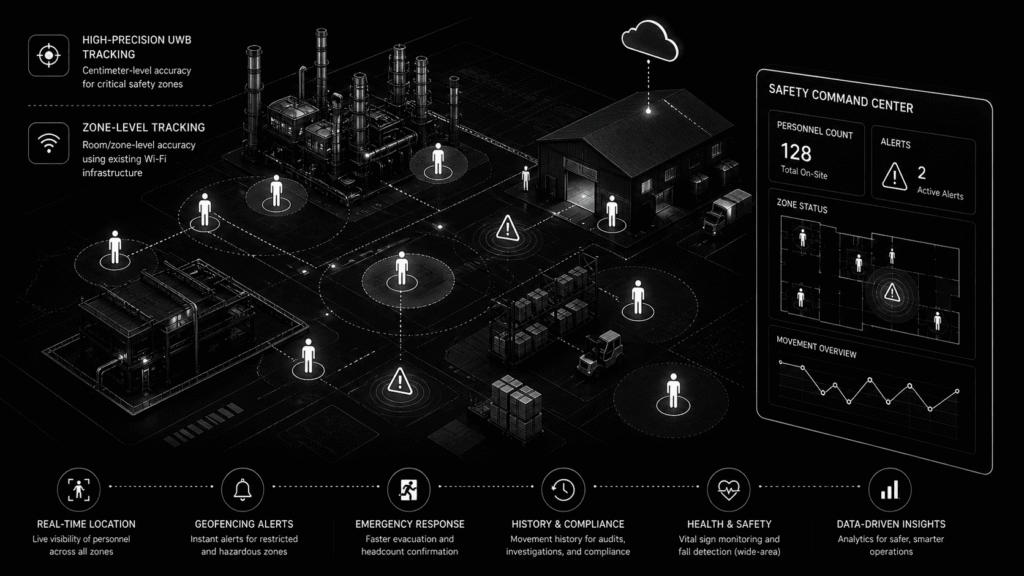
Automated warehouses require safety systems that operate at the same speed as the automation they protect. Vehicle collision prevention systems monitor forklift and robot proximity to personnel in real time. Indoor overhead safety solutions detect height clearance hazards. High-precision personnel tracking confirms worker location across all active zones. These systems integrate with the broader warehouse automation infrastructure to ensure personnel safety without limiting operational throughput.
Operational Benefits of Integrated Warehouse Automation
- Continuous 24/7 material handling without shift-related downtime
- Real-time inventory and asset visibility across all warehouse zones
- Reduced dependency on manual labor for repetitive transport tasks
- Centralized performance monitoring through integrated digital platforms
- Scalable deployment that accommodates operational growth without infrastructure replacement
Manusphere's Role in Warehouse Automation Deployment
Manusphere acts as a technology integrator and facilitator, combining robotic systems, IoT infrastructure, connectivity networks, safety systems, and digital intelligence platforms into unified warehouse automation architectures. Working with established global technology partners, the company designs and deploys integrated warehouse automation solutions aligned with the operational requirements of Saudi Arabian industrial and logistics environments.
The Future of Warehouse Operations in Saudi Arabia
As Saudi Arabia's logistics sector continues to expand, integrated warehouse automation will become an operational standard rather than a competitive advantage. Organizations that establish unified automation infrastructure now will be positioned to scale operations efficiently as throughput demands increase.
Disclaimer: This article is provided for informational purposes only. It describes warehouse automation technologies and Manusphere's integration services without representing performance guarantees or regulatory certifications.