
Robotic Forklifts and Autonomous Warehouse Logistics in Saudi Arabia (2026)
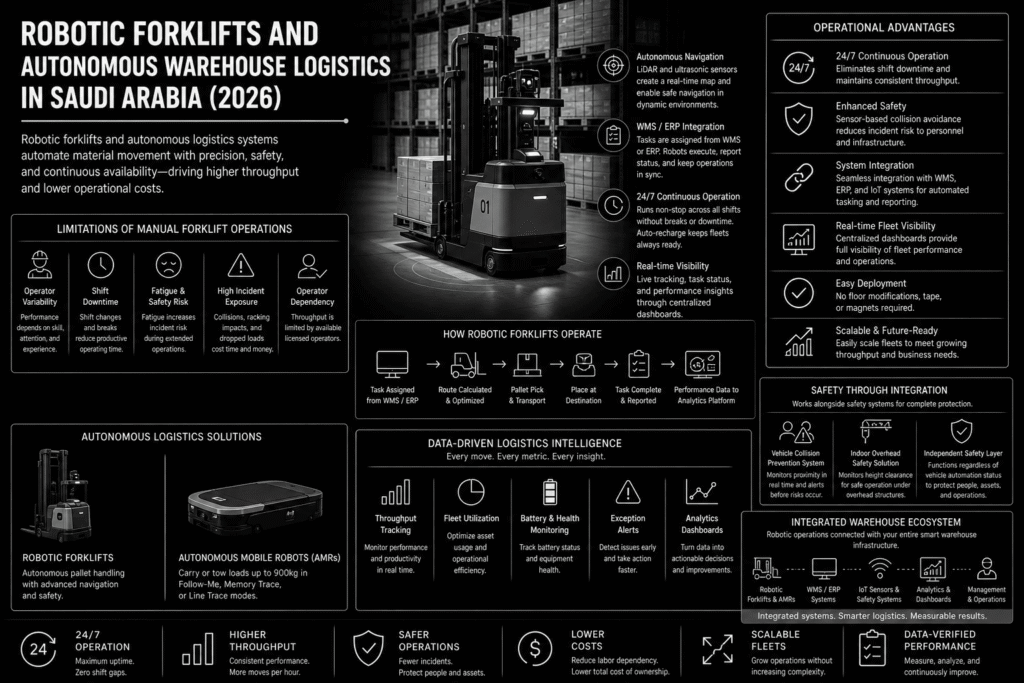
Warehouse and production-line logistics in Saudi Arabia face compounding operational pressures: the need for continuous material movement, increasing throughput demands, safety requirements in shared human-vehicle environments, and the operational cost of maintaining manually operated forklift fleets. Robotic forklifts and autonomous material handling systems address these pressures by automating repetitive transport operations with consistent precision and continuous availability.
At Manusphere, robotic forklifts and jacks are deployed as part of integrated warehouse automation systems, connecting autonomous material handling with IoT monitoring, safety infrastructure, and warehouse management platform integration.
Operational Limitations of Manual Forklift Operations
Manually operated forklifts introduce operational variability at multiple points: performance depends on operator skill and attentiveness; shift changes create productive downtime; fatigue increases incident risk during extended operations; and throughput capacity is directly constrained by the number of available licensed operators.
Forklift-related incidents, including collisions with personnel, racking impacts, and dropped loads, represent a significant safety and operational cost across warehouse and manufacturing environments. Many of these incidents occur in predictable conditions: high-traffic zones, blind corners, narrow aisle intersections, and end-of-shift periods when operator attention is reduced.
How Robotic Forklifts Operate
Manusphere's robotic forklifts and jacks operate autonomously using sensor-based navigation systems that create and continuously update a spatial model of the operating environment. LiDAR and ultrasonic obstacle detection provide real-time awareness of surrounding objects, personnel, and other vehicles, enabling safe navigation through dynamic warehouse layouts without requiring fixed infrastructure modifications such as floor tape, magnetic strips, or reflective markers.
Tasks are assigned through integration with warehouse management systems or ERP platforms. The robotic fleet receives pallet pick and place instructions, calculates optimal routes, executes transport operations, and reports completion status, creating a continuous data record of material movement activity accessible to management through centralized dashboards.
24/7 Continuous Operation
Robotic forklift systems operate continuously across all shift periods without performance degradation, scheduled breaks, or shift changeover downtime. For warehouses and production facilities operating extended or continuous hours, common across Saudi Arabia's manufacturing and logistics sectors, this eliminates a significant throughput constraint inherent to manually operated fleets. Automatic recharging systems maintain fleet availability by routing units to charging stations during operational gaps.
Integration with Collision Prevention and Safety Systems
In facilities where robotic forklifts and personnel share operational space, safety system integration is essential. Manusphere's vehicle collision prevention system monitors proximity between robotic vehicles, manually operated equipment, and personnel in real time, triggering alerts before threshold distances are breached. The indoor overhead safety solution monitors height clearance for tall equipment operating near overhead structures. These systems operate independently of robotic navigation, providing a dedicated safety layer that functions regardless of the vehicle's automation status.
Autonomous Mobile Robots for Bulk and Heavy Logistics
For applications requiring heavy load transport without the pallet handling capability of forklifts, Manusphere's bulk logistics robots and logistical robot platforms carry or tow loads up to 900kg in three navigation modes: Follow-Me, Memory Trace, and Line Trace, supporting flexible deployment across diverse material handling requirements without facility modification.
Fleet Management and Analytics Integration
Every robotic forklift and AMR in Manusphere's ecosystem generates operational data on task completion rates, travel distances, cycle times, battery status, and exception events. This data feeds into analytics platforms that provide management with fleet utilization visibility, throughput performance tracking, and maintenance scheduling intelligence. Visual analytics command centers convert logistics operations from an unmonitored cost center into a managed, data-verified performance function.
Operational Advantages of Autonomous Warehouse Logistics
- Continuous 24/7 operation without shift-related productive downtime
- Sensor-based collision avoidance reducing forklift-related incident exposure
- WMS and ERP integration enabling automated task assignment and status reporting
- Real-time fleet visibility through centralized management dashboards
- No facility infrastructure modifications required for deployment
- Scalable fleet expansion to accommodate throughput growth
Manusphere's Approach to Autonomous Logistics Deployment
Manusphere deploys robotic forklifts and autonomous logistics platforms as integrated components of warehouse automation systems, connected to safety infrastructure, IoT monitoring networks, and management analytics platforms. This integration approach ensures that autonomous logistics deployment delivers operational value beyond individual task automation, contributing to the facility-wide intelligence ecosystem that enables management to oversee and optimize the full scope of warehouse operations.
Disclaimer: This article is provided for informational purposes only. It describes robotic forklift and autonomous logistics technologies and Manusphere's integration services without representing performance guarantees or regulatory certifications.