
Pick-to-Light Systems: How Light-Directed Picking Improves Warehouse Efficiency (2026)
Pick-to-Light Systems: How Light-Directed Picking Improves Warehouse Efficiency (2026)
Order picking is the most labor-intensive and error-prone process in warehouse operations. In facilities processing hundreds or thousands of orders per shift, pick accuracy and speed directly determine customer satisfaction, return rates, and operational cost per order. Manual picking using paper lists or basic scanner systems creates bottlenecks that scale poorly as order volumes increase.
Manusphere deploys pick-to-light systems that use visual indicators at each storage location to guide operators directly to the correct item and quantity, eliminating search time and reducing pick errors to near zero.
How Pick-to-Light Technology Works
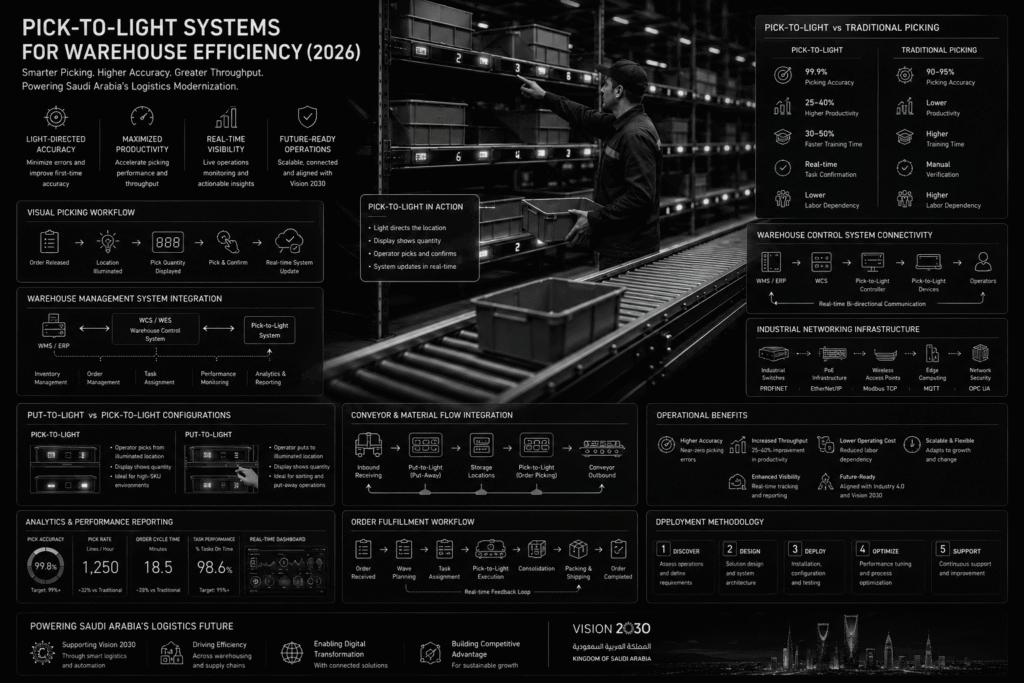
Pick-to-light systems mount LED displays and indicator lights at each bin, shelf, or storage location within a picking zone. When an order is released, the system illuminates the lights at the locations containing required items and displays the quantity to pick. The operator moves to the illuminated location, picks the indicated quantity, and confirms the pick by pressing a button on the display module. The system then advances to the next required location.
This visual direction eliminates the need for operators to read paper lists, interpret scanner screens, or search for item locations. The result is faster pick cycles and significantly fewer errors compared to conventional picking methods.
Where Pick-to-Light Delivers the Highest Impact
Pick-to-light systems are most effective in operations with high-frequency SKUs, batch picking workflows, and environments where multiple operators work simultaneously in shared picking zones. E-commerce fulfillment centers, pharmaceutical distribution facilities, electronics warehouses, and retail distribution operations all benefit from light-directed picking, particularly when order accuracy requirements are strict and order volumes are high.
In put-to-light configurations, the same technology directs operators during order consolidation, lighting the correct order container for each item during batch-to-order sorting processes.
Integration with Warehouse Automation Infrastructure
Pick-to-light systems operate most effectively when integrated with the broader warehouse automation stack. Warehouse control systems (WCS) sequence pick orders and coordinate light activation with conveyor systems that deliver totes to picking stations and transport completed orders to packing zones. Warehouse management systems (WMS) manage inventory allocation and order release logic that feeds the pick-to-light controllers.
This integration creates a picking workflow where orders flow automatically from the management system through the pick zone and onto conveyors for packing and dispatch, with minimal manual coordination required.
Networking Requirements for Pick-to-Light Deployments
Pick-to-light systems depend on reliable, low-latency communication between controllers, display modules, and upstream management systems. Industrial Ethernet switches provide the network backbone for these systems, ensuring that pick instructions reach display modules without delay. In facilities where wireless connectivity supports mobile devices or handheld scanners used alongside pick-to-light zones, industrial wireless networks complement the wired infrastructure.
Operational Advantages of Pick-to-Light Systems
- Significantly reduced pick error rates compared to paper or scanner-based methods
- Faster pick cycle times through visual guidance that eliminates search time
- Shorter operator training periods due to intuitive visual interface
- Real-time pick progress visibility for supervisors and management systems
- Scalable deployment from single zones to full-facility coverage
- Adaptable to both pick-to-light and put-to-light operational configurations
Manusphere's Deployment Methodology
Manusphere integrates pick-to-light systems within complete warehouse automation architectures. Each deployment begins with an assessment of order profiles, SKU velocity distribution, facility layout, and existing infrastructure. The system is then configured and connected to conveyor networks, control systems, and digital platforms to deliver a picking workflow that operates as part of the unified facility automation environment.
Disclaimer: This article is provided for informational purposes only. It describes pick-to-light technologies and Manusphere's integration services without representing performance guarantees or regulatory certifications.