
OT Cybersecurity: Securing Industrial Networks and Control Systems in Saudi Arabia (2026)
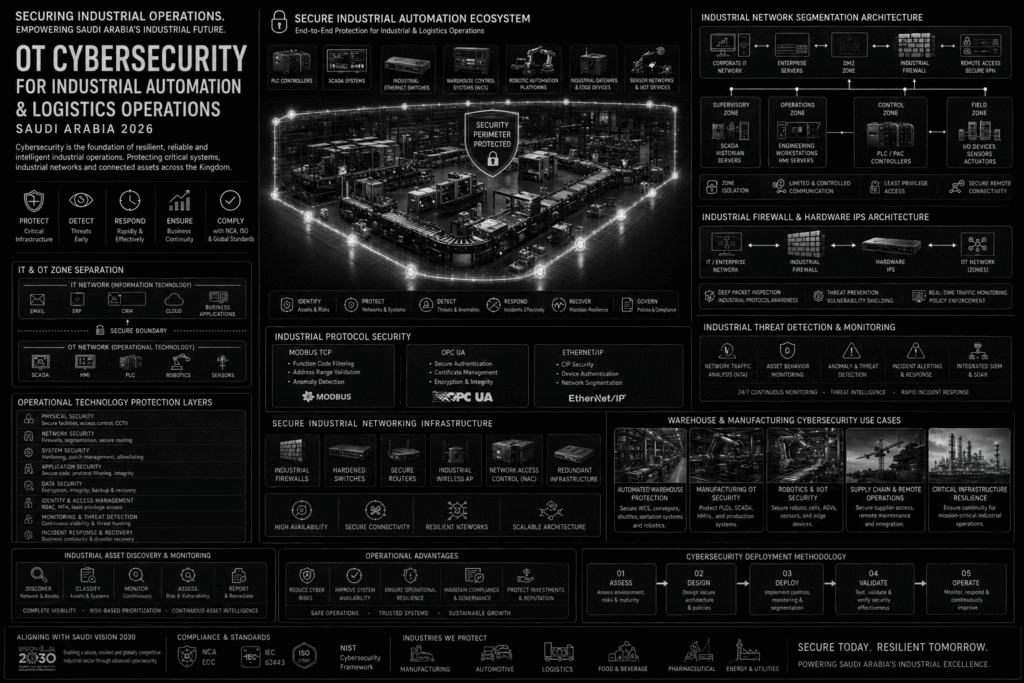
As industrial facilities in Saudi Arabia connect operational technology (OT) systems to digital networks, they introduce cybersecurity risks that did not exist when these systems operated in isolation. Programmable logic controllers, SCADA systems, industrial switches, robotic controllers, and sensor networks were originally designed for reliability and availability, not for defending against network-based threats. Connecting these systems to enterprise IT networks and cloud platforms creates attack surfaces that require dedicated OT security measures.
At Manusphere, industrial cybersecurity is deployed as a core layer within every automation architecture, not as an afterthought applied once systems are already in production.
Why OT Cybersecurity Requires a Distinct Approach
IT cybersecurity and OT cybersecurity address fundamentally different priorities. In IT environments, confidentiality typically ranks as the highest concern. In OT environments, availability and safety take precedence. An industrial control system that goes offline due to a security tool's false positive can halt production, damage equipment, or create physical safety hazards. OT cybersecurity solutions must protect networks without disrupting the real-time control processes that keep facilities operating.
This distinction means that conventional IT security tools, including endpoint antivirus, automated patching, and aggressive network scanning, are often unsuitable for deployment on OT networks without significant adaptation.
OT Network Security Architecture
OT network security begins with network segmentation, separating operational technology zones from enterprise IT networks and establishing controlled access points between them. Industrial firewalls and hardware-based intrusion prevention systems (IPS) inspect traffic inline at zone boundaries, blocking unauthorized protocols and anomalous traffic patterns before they reach control systems. These hardware IPS appliances operate at wire speed without introducing latency that could affect control loop timing.
Industrial Threat Detection
Industrial threat detection systems monitor OT network traffic for indicators of compromise, unauthorized device connections, protocol anomalies, and behavioral deviations from established baselines. These systems understand industrial protocols such as Modbus, OPC UA, and EtherNet/IP, enabling them to identify threats that generic IT security tools would miss. Continuous monitoring provides security teams with visibility into OT network activity without requiring agents installed on sensitive control devices.
Secure Industrial Infrastructure Design
Secure industrial infrastructure integrates cybersecurity into the design of automation networks from the outset. This includes hardened industrial Ethernet switches with built-in access control, secure industrial gateways that enforce protocol filtering between network zones, and encrypted communication channels for data transmitted between OT and IT environments.
OT Cybersecurity in Automated Facilities
Automated warehouses, robotic manufacturing cells, and connected logistics environments face concentrated cybersecurity risk because they combine high-value equipment, real-time control requirements, and extensive network connectivity. A compromised warehouse control system could misdirect material flow. A breached robotic automation platform could create physical safety hazards. OT cybersecurity protects these systems at the network level, ensuring that automation infrastructure remains available, accurate, and under authorized control.
Critical Capabilities for OT Cybersecurity
- Network segmentation between IT and OT environments with controlled access points
- Hardware-based inline intrusion prevention at OT zone boundaries
- Continuous OT network monitoring with industrial protocol awareness
- Asset discovery and inventory across connected OT devices
- Threat detection tuned for industrial control system environments
- Security architecture that preserves OT system availability and real-time performance
Manusphere's OT Cybersecurity Deployment
Manusphere integrates OT cybersecurity as a standard layer within industrial automation ecosystem deployments. Security architecture is designed alongside industrial networking infrastructure, ensuring that network segmentation, threat detection, and access control are embedded in the automation architecture from initial design through commissioning. This approach ensures that cybersecurity protects operational technology without constraining the performance or availability that industrial systems require.
Disclaimer: This article is provided for informational purposes only. It describes OT cybersecurity technologies and Manusphere's integration services without representing performance guarantees or regulatory certifications.