
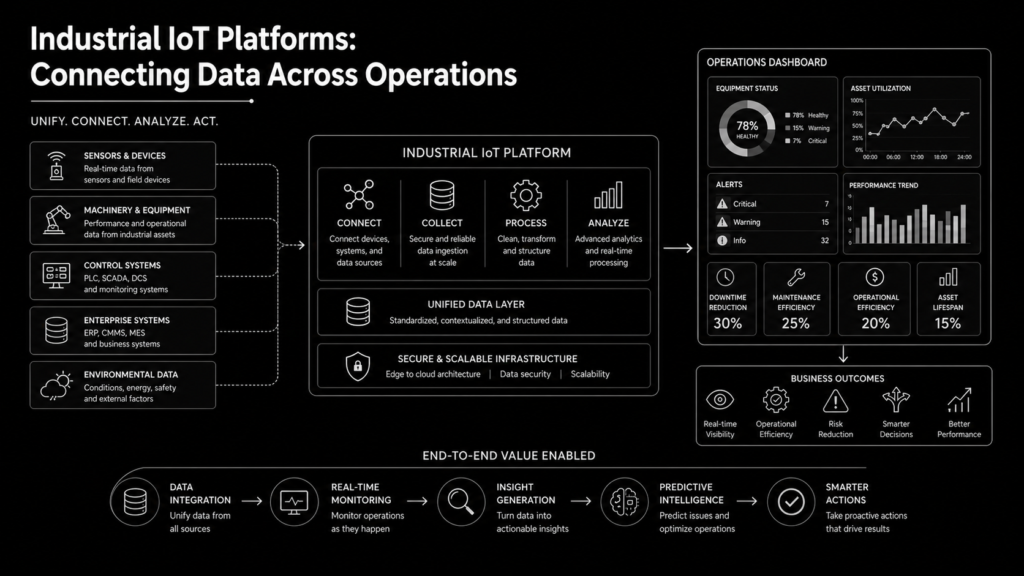
Industrial IoT Platforms: Connecting Data Across Operations
In today’s industrial environments, data is generated everywhere — from machines and sensors to systems and operational workflows. However, in many organizations, this data remains fragmented, stored across disconnected platforms, and underutilized.
Industrial IoT platforms address this challenge by creating a unified digital layer that connects devices, systems, and data streams into a single, structured ecosystem. By enabling seamless data integration, these platforms transform isolated information into actionable intelligence that supports smarter, faster, and more informed decision-making. Learn more about our Industrial Data & AI Intelligence solutions.
What Is an Industrial IoT Platform?
An Industrial IoT (IIoT) platform is a centralized system that collects, processes, and manages data from multiple industrial sources. It connects sensors, machines, and operational systems to provide a real-time view of performance across facilities.
These platforms are built on connected infrastructure such as IoT solutions and intelligent networks that unify operational data streams.
- Connected sensors and devices
- Industrial equipment and machinery
- Monitoring and control systems
- Data analytics and visualization tools
Breaking Down Data Silos in Industrial Operations
One of the most common challenges in industrial environments is the presence of data silos. Different systems often operate independently, making it difficult to access and analyze information across the organization.
By integrating systems through platforms like data engineering solutions, organizations can eliminate fragmentation and enable seamless communication between systems.
- Integrating multiple data sources into a single platform
- Standardizing data formats for easier analysis
- Enabling communication between legacy and modern systems
- Providing centralized dashboards for visibility
Enabling Real-Time Operational Visibility
Real-time visibility is a key advantage of Industrial IoT platforms. Instead of relying on delayed reports, organizations can monitor operations as they happen.
With advanced dashboards such as visual analytics platforms, teams gain actionable insights across operations.
- Track equipment performance and utilization
- Monitor environmental conditions
- Identify anomalies and inefficiencies
- Respond quickly to operational changes
Supporting Predictive Maintenance and Efficiency
Industrial IoT platforms play a critical role in enabling predictive maintenance strategies. By continuously analyzing data from equipment and sensors, these platforms can detect patterns that indicate potential issues before they lead to failure.
These capabilities are enhanced through data science and predictive analytics that improve operational reliability.
- Reduce unplanned downtime
- Optimize maintenance schedules
- Extend asset lifespan
- Improve resource allocation
Integration with AI and Advanced Analytics
When combined with AI and advanced analytics, Industrial IoT platforms become even more powerful. Data collected from connected systems can be analyzed to generate insights, forecasts, and recommendations.
This is further enabled through AI and generative intelligence solutions that transform raw data into decision-ready insights.
- Pattern recognition and anomaly detection
- Data-driven decision support
- Continuous performance optimization
- Automated reporting and insights
Conclusion
Industrial IoT platforms are redefining how industrial operations manage and utilize data. By connecting systems, eliminating silos, and enabling real-time insights, these platforms empower organizations to make smarter decisions and improve operational performance.
Disclaimer: This article is provided for informational purposes only. It describes Industrial IoT technologies and integration approaches without representing performance guarantees or regulatory certifications.
FAQ
What is an Industrial IoT platform?
An Industrial IoT (IIoT) platform is a centralized system that connects sensors, machines, and operational systems to collect, process, and analyze data in real time. It enables organizations to monitor performance, improve efficiency, and make data-driven decisions.
How do Industrial IoT platforms improve operations?
Industrial IoT platforms improve operations by providing real-time visibility, enabling predictive maintenance, and integrating data from multiple systems. This helps reduce downtime, optimize resources, and improve efficiency.
What are data silos in industrial environments?
Data silos occur when information is stored in separate systems that do not communicate with each other. This limits visibility and makes it difficult to analyze data effectively across operations.
Can Industrial IoT platforms support predictive maintenance?
Yes, Industrial IoT platforms support predictive maintenance by continuously analyzing data from sensors and equipment to detect early signs of potential failures before they occur.
What is the difference between Industrial IoT and standard IoT?
Industrial IoT focuses on applications in industrial environments such as manufacturing and infrastructure, while standard IoT typically refers to consumer devices like smart home systems.
How do Industrial IoT platforms integrate with AI?
Industrial IoT platforms provide structured data that AI systems analyze to detect patterns, generate insights, and support decision-making processes.
Are Industrial IoT platforms scalable?
Yes, Industrial IoT platforms are designed to scale, allowing organizations to expand from small deployments to full operational integration across multiple facilities.
Which industries benefit from Industrial IoT platforms?
Industries such as manufacturing, logistics, energy, and facility operations benefit from Industrial IoT platforms by improving efficiency, visibility, and operational control.