
Conveyor Systems for Industrial and Logistics Automation in Saudi Arabia (2026)
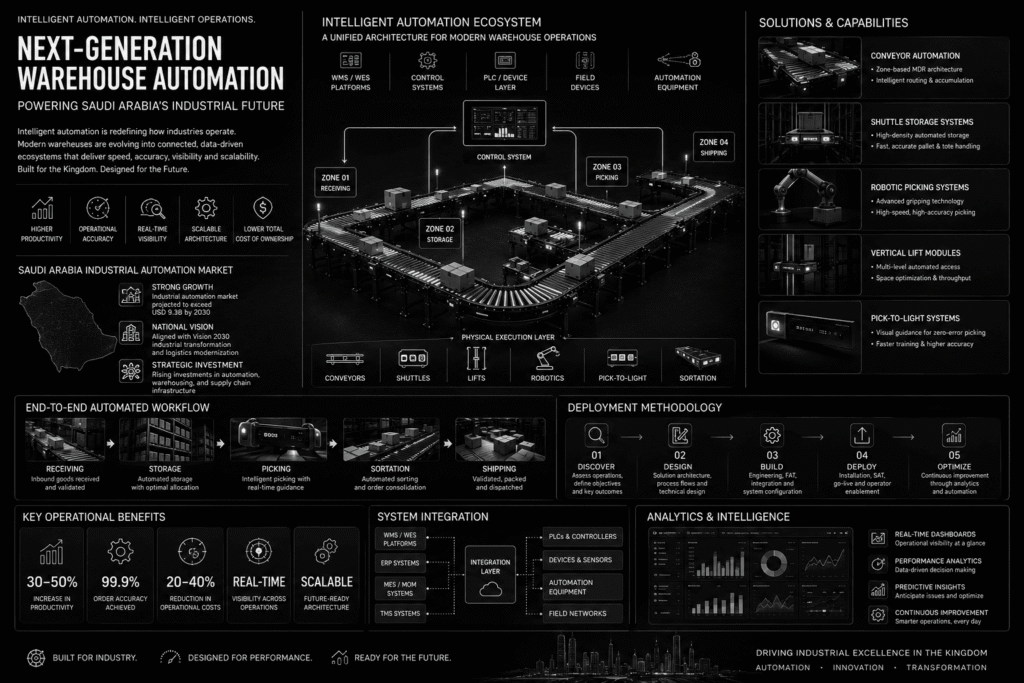
Conveyor systems remain the most fundamental material handling technology in industrial and logistics operations. In Saudi Arabia's expanding warehouse, manufacturing, and distribution environments, conveyors provide the physical infrastructure that moves products between receiving, storage, processing, picking, and shipping zones. Without reliable conveyor infrastructure, even the most advanced robotics and software platforms cannot achieve consistent throughput.
At Manusphere, we deploy conveyor and material handling systems as part of integrated automation architectures, connecting physical material flow to digital control platforms across industrial facilities.
Why Conveyors Are Central to Automation Strategy
Robotic systems, automated storage, and digital platforms generate operational value only when products move reliably between stations. Conveyors provide that reliability. They handle continuous, predictable material movement at speeds and volumes that manual transport cannot sustain. In high-throughput environments such as e-commerce fulfillment centers, food and beverage distribution, and pharmaceutical logistics, conveyors are not optional equipment. They are core infrastructure.
Motor-Driven Roller (MDR) Technology
Motor-driven roller (MDR) systems represent the current standard in energy-efficient conveyor design. Unlike conventional belt conveyors powered by centralized motors, MDR conveyors embed individual motorized rollers within each zone. Each zone operates independently, activating only when product is detected and stopping when the zone is clear. This zone-based activation reduces energy consumption, minimizes mechanical wear, and lowers noise levels across the facility.
MDR technology is particularly well-suited to operations that handle mixed product sizes or require accumulation without back-pressure, where items must queue without physical contact between products.
Conveyor Automation and Control
Conveyor automation platforms manage the logic that controls product routing, merging, diverting, sorting, and accumulation. These systems use sensors, scanners, and programmable controllers to direct each item to its correct destination based on order data, product attributes, or processing requirements.
Conveyor control platforms provide centralized management of conveyor networks, enabling operators to monitor system status, identify faults, adjust throughput parameters, and coordinate conveyor operations with other automation equipment in the facility.
Integration with Warehouse Systems
Conveyors deliver their full value when connected to the broader automation and digital infrastructure. Warehouse control systems (WCS) coordinate conveyor activity with robotic picking stations, pick-to-light systems, and automated storage zones. Warehouse management systems (WMS) provide the order data that drives conveyor routing decisions. Industrial networking infrastructure ensures real-time communication between conveyor controllers and facility management platforms.
Applications Across Saudi Industrial Sectors
Conveyor systems serve a wide range of operational environments in Saudi Arabia. Distribution centers use high-speed sortation conveyors to process thousands of parcels per hour. Manufacturing plants use conveyors to link production lines, assembly stations, and packaging zones. Airport cargo facilities, cold storage operations, and food processing plants all rely on conveyor infrastructure designed to meet their specific handling, hygiene, and environmental requirements.
Operational Advantages of Modern Conveyor Systems
- Continuous, high-volume material movement between operational zones
- Energy-efficient zone-based activation through MDR technology
- Automated sorting and routing based on product and order data
- Reduced manual handling and associated injury risk
- Scalable layouts that adapt to facility expansion and volume growth
- Real-time monitoring and fault detection through centralized control platforms
Manusphere's Conveyor Deployment Approach
Manusphere deploys conveyor infrastructure as a systems integrator, selecting and configuring technologies from global manufacturing partners to match each facility's throughput requirements, product profiles, and spatial constraints. Conveyor systems are designed as part of the broader industrial automation ecosystem, integrated with robotics, digital platforms, networking, and cybersecurity infrastructure to create unified material handling environments.
For Saudi facilities planning new builds or modernizing existing operations, conveyor system design is the foundation on which all other automation technologies depend.
Disclaimer: This article is provided for informational purposes only. It describes conveyor system technologies and Manusphere's integration services without representing performance guarantees or regulatory certifications.