
Autonomous Cleaning Robots for Large-Scale Facilities in Saudi Arabia (2026)
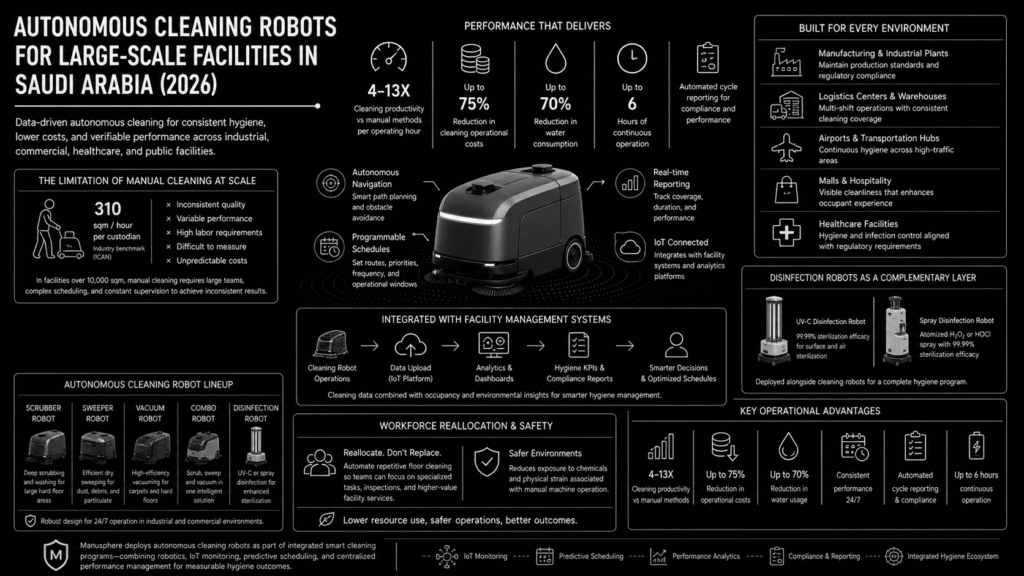
Large-scale facility cleaning in Saudi Arabia, across manufacturing plants, logistics centers, airports, malls, and healthcare environments, faces a consistent operational challenge: maintaining hygiene standards with consistent coverage, predictable costs, and verifiable performance across expansive floor areas and multi-shift operations.
Autonomous cleaning robots address this challenge by replacing variable manual processes with data-driven, autonomous systems that maintain consistent performance independent of workforce scheduling constraints. At Manusphere, autonomous cleaning robots are deployed as core components of integrated facility hygiene systems, combining cleaning performance with operational data reporting and IoT connectivity.
The Operational Limitation of Manual Cleaning at Scale
The ICAN (International Custodial Advisors Network) benchmark for manual facility cleaning is approximately 310 sqm per hour per custodian under standard conditions. In large facilities exceeding 10,000 sqm, common across Saudi Arabia's industrial and commercial sector, achieving consistent coverage requires significant staffing, scheduling coordination, and ongoing supervision.
Manual cleaning also introduces variability: cleaning quality depends on individual performance, physical fatigue, shift handovers, and the absence of objective performance measurement. These variables accumulate into inconsistent hygiene standards and unpredictable operational costs.
Autonomous Cleaning Performance Parameters
Manusphere's autonomous cleaning robots deliver 4 to 13 times the cleaning productivity of manual methods, covering vastly larger areas per operating hour with consistent technique application regardless of shift timing or workforce availability. Each robot operates for up to 6 continuous hours per charge, maintaining cleaning operations through periods when manual scheduling would require shift changes or breaks.
Water consumption is reduced by up to 70% compared to conventional machine-assisted cleaning methods, and operational cost reductions of up to 75% are achievable through the combined effect of labor substitution and resource efficiency.
Autonomous Navigation and Route Management
Cleaning robots navigate facilities using autonomous path planning and obstacle avoidance systems, operating independently without requiring pre-programmed fixed routes for every operational session. Cleaning routes and schedules are programmable, allowing facility managers to define coverage priorities, frequency schedules, and operational time windows through management interfaces. Real-time performance reporting documents each cleaning cycle, including route coverage, duration, areas cleaned, and any operational exceptions.
Integration with Facility Management Systems
Autonomous cleaning robots within the Manusphere ecosystem integrate with the broader facility management infrastructure. Cleaning performance data feeds into analytics platforms that enable facility managers to track hygiene KPIs, identify coverage gaps, and optimize cleaning schedules based on actual usage patterns captured by occupancy sensors and environmental monitoring devices deployed across the facility.
Disinfection Robotics as a Complementary Layer
For environments requiring sterilization beyond routine cleaning, Manusphere's disinfection robots operate alongside cleaning systems as part of a coordinated hygiene program. The UV-C Disinfection Robot and Spray Disinfection Robot provide 99.99% sterilization efficacy in environments where cleaning alone is insufficient for compliance requirements.
Workforce Reallocation and Safety
Autonomous cleaning does not eliminate cleaning staff. It reallocates them. By automating routine floor cleaning cycles, facility teams are freed to focus on specialized cleaning tasks, quality inspection, and higher-value facility management activities. Worker exposure to cleaning chemicals and the physical strain associated with manual machine operation are reduced, contributing to improved workforce safety conditions aligned with Manusphere's broader integrated safety framework.
Applicable Environments in Saudi Arabia
Autonomous cleaning robot deployments are directly applicable across Saudi Arabia's large-footprint facility categories: manufacturing and industrial plants where floor hygiene directly impacts production quality and compliance; logistics centers and warehouses operating multiple shifts; airports and transportation hubs requiring continuous cleaning throughout operational hours; commercial malls and hospitality environments where cleaning visibility affects occupant perception; and healthcare facilities where hygiene standards are subject to regulatory requirements.
Operational Advantages of Autonomous Cleaning
- 4 to 13 times cleaning productivity versus manual methods per operating hour
- Up to 75% reduction in cleaning operational costs
- Up to 70% reduction in water consumption
- Consistent performance independent of shift schedules or workforce availability
- Automated cycle reporting for compliance documentation and performance management
- Up to 6 continuous operating hours per charge
Manusphere's Cleaning Automation Deployment
Manusphere deploys autonomous cleaning robots as part of integrated smart cleaning programs that combine robotic systems with IoT environmental monitoring, predictive hygiene scheduling, and centralized performance management. This approach transforms facility cleaning from a routine operational cost into a managed, data-verified performance function with measurable outcomes and documented compliance records within the facility management ecosystem.
Disclaimer: This article is provided for informational purposes only. It describes autonomous cleaning robot technologies and Manusphere's integration services without representing performance guarantees or regulatory certifications.