
Industrial Data Strategy: How Saudi Organizations Build Operational Intelligence Infrastructure (2026)
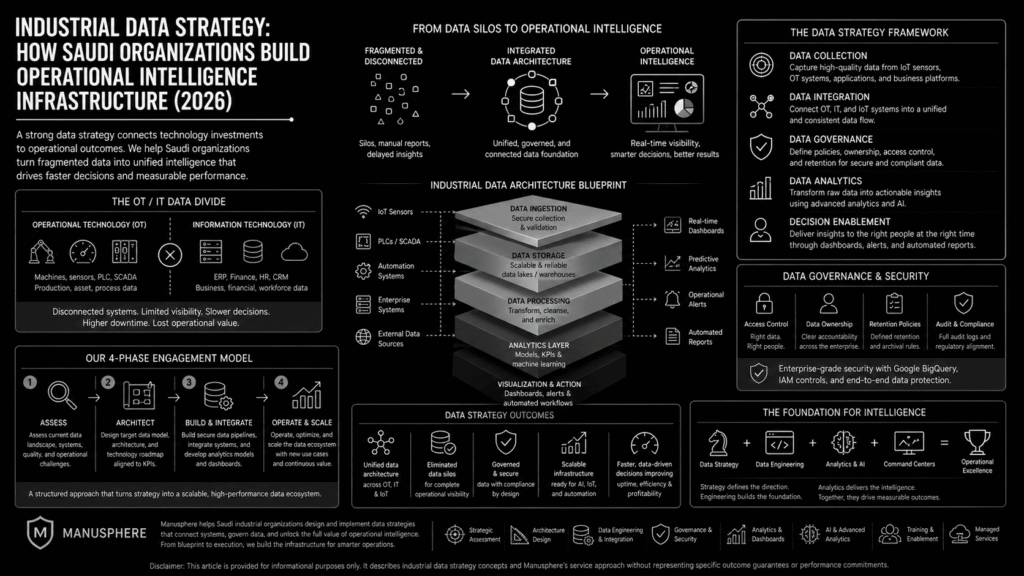
Industrial organizations in Saudi Arabia are investing in connected technology across facilities, deploying IoT sensors, automation systems, and analytics platforms at increasing scale. The operational value of these investments is determined not by the technology itself, but by the data architecture that connects them. Without a defined data strategy, technology deployments generate fragmented data that reaches decision-makers too late, in formats that require manual interpretation, from systems that cannot communicate with each other.
At Manusphere, industrial data strategy and architecture is delivered as the foundational layer of the Data and AI Intelligence Suite, ensuring that every technology deployment contributes to a governed, integrated operational intelligence infrastructure.
What Is an Industrial Data Strategy?
An industrial data strategy defines how an organization collects, stores, governs, integrates, and utilizes operational data to support decision-making. For industrial environments, this encompasses data generated by operational technology systems, including sensors, PLCs, SCADA systems, and automation platforms, as well as information technology systems including ERP, finance, HR, and customer platforms.
A data strategy addresses the architecture of data storage and flow, the governance policies controlling data access and retention, the integration approach connecting disparate systems, and the analytics framework converting raw data into operational intelligence.
The OT/IT Integration Challenge in Saudi Industrial Operations
Most Saudi industrial organizations operate with a fundamental separation between operational technology systems and information technology systems. OT data, including machine performance metrics, sensor readings, production rates, and equipment status, remains in operational silos. IT data, including financial performance, procurement, and workforce data, resides in enterprise systems that have no visibility into plant floor conditions.
This separation means that maintenance decisions are made without visibility into financial impact. Production decisions are made without real-time asset performance data. Leadership receives reports that combine data from systems that have never been integrated, producing metrics that require manual reconciliation before they can inform strategic decisions.
Building the Data Architecture Blueprint
Manusphere's Data Strategy and Architecture service begins with a comprehensive assessment of existing data systems, sources, quality, and operational objectives. This assessment identifies the high-value integration opportunities where connecting currently siloed data sources would produce the most significant improvements in operational decision speed and accuracy.
The architecture blueprint defines data flow from IoT sensors and OT systems through processing layers to analytics platforms, establishing the technical framework that every subsequent deployment component operates within.
Data Governance and Security in Industrial Environments
Industrial operational data is sensitive. A data strategy must define access control policies that ensure the right personnel have access to relevant data while proprietary operational information is protected from unauthorized access. Manusphere's architecture deployments establish governance frameworks with defined data ownership, retention policies, access control, and audit logging. Google BigQuery deployments include enterprise IAM configurations maintaining client control over all proprietary operational data.
From Strategy to Execution: The Four-Phase Engagement Model
Manusphere's data strategy engagement follows a structured four-phase process: assessing the current data landscape and operational challenges; architecting the target data model and technology roadmap aligned with business KPIs; building and integrating secure data pipelines, analytics models, and command center dashboards; and operating and scaling the intelligence ecosystem through continuous optimization and new use case deployment.
The Role of Data Engineering in Strategy Execution
Data engineering converts the data strategy blueprint into operational infrastructure, building the pipelines, warehouses, and integration layers that physically move and structure data from source systems to analytics platforms. Together, data strategy and data engineering form the foundation upon which advanced analytics, visual command centers, AI automation, and automated reporting through PBI FLOW deliver operational value.
Data Strategy Outcomes for Saudi Industrial Operations
- Unified data architecture connecting OT, IT, and IoT data sources
- Elimination of data silos preventing cross-system operational visibility
- Governance framework ensuring data security and regulatory compliance
- Scalable infrastructure designed to accommodate future IoT, AI, and automation deployments
- Faster operational decision-making through real-time verified data access
Manusphere's Industrial Data Strategy Approach
Manusphere delivers industrial data strategy and architecture as a consulting and implementation service, combining strategic assessment, technical architecture design, governance framework development, and phased implementation support. The engagement model is aligned with client-specific operational KPIs, ensuring that data infrastructure investments translate directly into measurable improvements in uptime, efficiency, compliance, and decision speed across the full Data and AI Intelligence Suite.
Disclaimer: This article is provided for informational purposes only. It describes industrial data strategy concepts and Manusphere's service approach without representing specific outcome guarantees or performance commitments.