
Wi-Fi 6 for Industrial Facilities: Enterprise Wireless Connectivity in Saudi Arabia (2026)
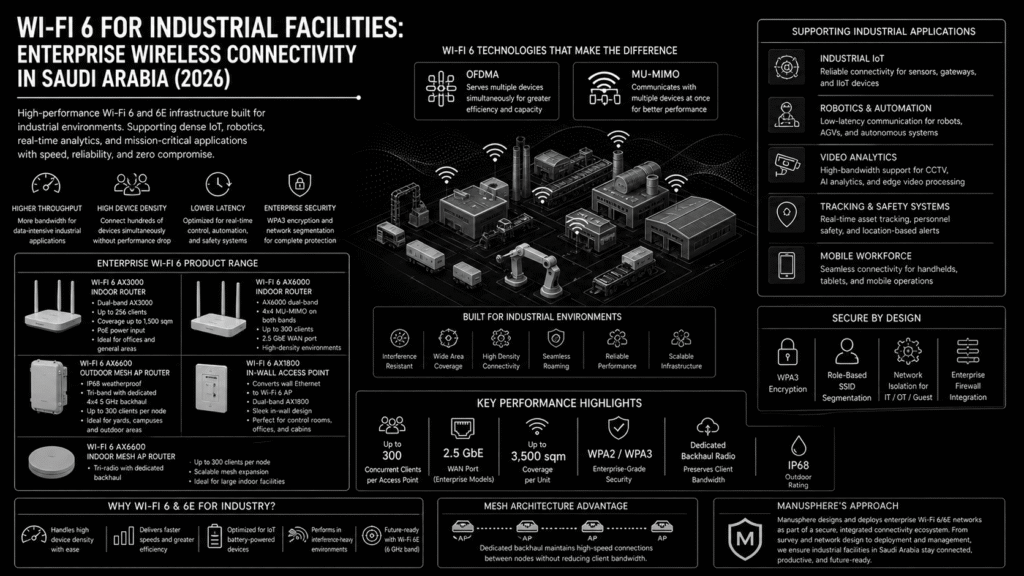
Industrial facilities in Saudi Arabia are deploying increasing numbers of wireless devices, including IoT sensors, robotic systems, tracking platforms, video analytics cameras, and mobile workforce devices. Legacy Wi-Fi infrastructure was not designed for the device density, electromagnetic interference conditions, and mission-critical latency requirements that modern industrial environments demand. Wi-Fi 6 and Wi-Fi 6E address these limitations through fundamental advances in wireless technology architecture.
At Manusphere, enterprise Wi-Fi 6 and 6E solutions are deployed as the high-bandwidth connectivity layer within industrial facility networks, supporting robotics coordination, real-time analytics, and dense IoT device environments.
What Makes Wi-Fi 6 Different from Previous Standards
Wi-Fi 6 (802.11ax) introduces two critical technologies that directly address industrial wireless performance challenges: OFDMA (Orthogonal Frequency Division Multiple Access) and MU-MIMO (Multi-User Multiple Input, Multiple Output). Together, these technologies allow a single access point to serve multiple devices simultaneously with dedicated bandwidth allocation, rather than having devices compete for channel access sequentially.
In industrial environments where dozens or hundreds of devices operate concurrently within the same wireless space, this architectural change produces measurably lower latency, higher throughput per device, and more reliable performance under high device density conditions.
Wi-Fi 6E and the 6 GHz Spectrum Advantage
Wi-Fi 6E extends the Wi-Fi 6 standard into the 6 GHz frequency band, providing access to significantly more spectrum than the congested 2.4 GHz and 5 GHz bands used by previous Wi-Fi generations. In industrial environments where the 5 GHz band is already occupied by existing infrastructure, the 6 GHz band provides clean, interference-free spectrum for latency-sensitive applications.
Manusphere deploys the Wi-Fi 6E AXE6600 Tri-Band Router, which operates simultaneously across 2.4 GHz, 5 GHz, and 6 GHz bands, delivering up to 4,800 Mbps on the 6 GHz band alone with 4x4 spatial streams and 160 MHz channel width.
Industrial Wi-Fi 6 Product Range
Manusphere's Wi-Fi 6 infrastructure portfolio covers diverse industrial deployment requirements.
The Wi-Fi 6 AX3000 Indoor Router provides dual-band coverage for up to 256 concurrent clients across approximately 1,500 sqm per unit, with PoE power input for flexible ceiling mounting.
The Wi-Fi 6 AX6000 Indoor Router supports 4x4 MU-MIMO on both bands with aggregate throughput up to 6,000 Mbps, a 2.5 GbE WAN port, and capacity for 300 concurrent devices, making it suitable for high-density manufacturing and logistics environments.
The Wi-Fi 6 AX6600 Outdoor Mesh AP Router provides IP68-rated outdoor coverage for industrial yards, logistics compounds, and inter-building wireless connectivity, with a dedicated 4x4 5 GHz backhaul radio and support for 300 clients per node.
The Wi-Fi 6 AX1800 In-Wall Access Point converts standard Ethernet wall outlets into Wi-Fi 6 access points, providing localized coverage in offices, control rooms, and technical areas without ceiling-mounted infrastructure.
The Wi-Fi 6 AX6600 Indoor Mesh AP Router delivers tri-radio performance with a dedicated backhaul radio, supporting up to 300 clients per node and scalable mesh expansion across large indoor facilities.
Supporting Industrial IoT and Robotics Applications
Wi-Fi 6 infrastructure in industrial facilities directly supports the performance of systems that depend on reliable wireless connectivity. Robotic platforms require low-latency command and telemetry communication. IoT sensor gateways use Wi-Fi backhaul for data transmission to cloud platforms. Collision prevention systems and personnel tracking platforms depend on consistent network availability for real-time alert transmission.
Mesh Architecture for Large-Area Coverage
Manusphere's Wi-Fi 6 mesh solutions use dedicated backhaul radios to maintain high-speed connections between access point nodes, ensuring that adding coverage through additional mesh nodes does not reduce available bandwidth for connected devices. This architecture supports large-area industrial deployments where Ethernet cabling to every access point location is not practical or cost-effective.
Security Standards in Industrial Wi-Fi Deployments
All Manusphere Wi-Fi 6 deployments support WPA3 encryption alongside role-based SSID segmentation that isolates operational technology networks from corporate and guest access networks. This network segmentation is a fundamental component of industrial cybersecurity architecture, limiting exposure between network segments without requiring separate physical infrastructure.
Key Performance Parameters for Industrial Deployments
- Up to 300 concurrent client devices per access point on enterprise models
- 2.5 GbE WAN port uplink on enterprise models
- IP68 environmental rating on outdoor mesh units
- WPA2/WPA3 wireless security across all models
- Up to 3,500 sqm coverage per unit on enterprise models
- Dedicated backhaul radio in mesh configurations preserving client bandwidth
Manusphere's Wi-Fi 6 Deployment Approach
Manusphere deploys Wi-Fi 6 infrastructure as an integrated component of the industrial facility connectivity ecosystem, coordinated with LoRaWAN® sensor networks, IoT platforms, and operational management systems. Network design is based on facility-specific coverage requirements, device density, interference environment, and security architecture to ensure reliable performance across the full range of operational applications.
Disclaimer: This article is provided for informational purposes only. It describes Wi-Fi 6 technology and Manusphere's deployment services without representing specific coverage guarantees or performance specifications applicable to all installation environments.