
Integrated Industrial Systems: Connecting IoT, Data, and AI for Operational Excellence
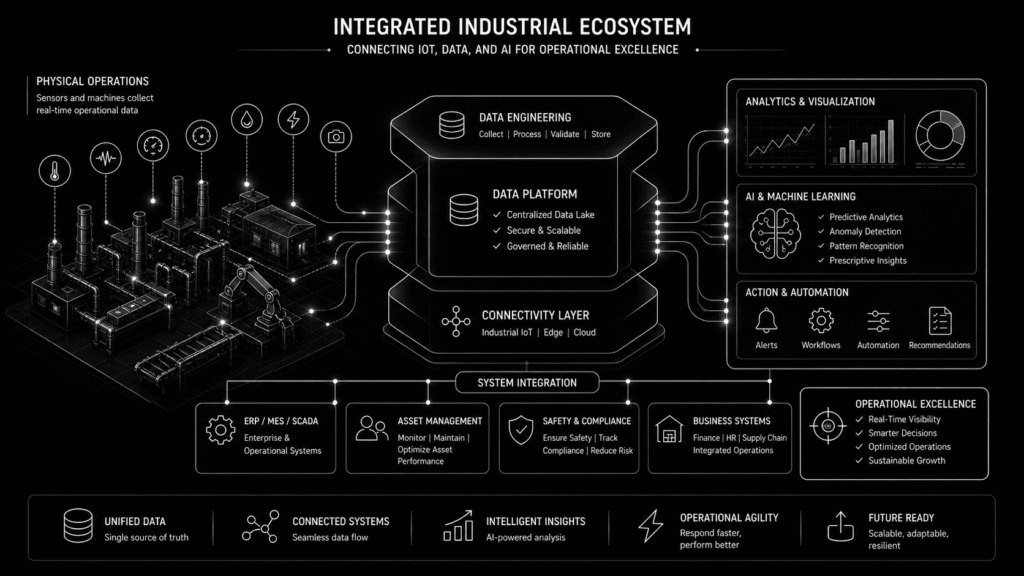
Modern industrial environments rely on multiple technologies, including IoT systems, data platforms, analytics tools, and AI solutions. However, when these systems operate independently, organizations face challenges in achieving full visibility and efficiency.
Integrated industrial systems bring these technologies together into a unified ecosystem. By connecting IoT, data engineering, analytics, and AI, organizations can create a seamless flow of information that supports smarter operations and better decision-making.
What Are Integrated Industrial Systems?
Integrated industrial systems combine multiple technologies into a single connected framework. This includes linking sensors, machines, data platforms, and analytics tools to create a unified operational environment.
Through IoT solutions, data is collected from physical systems and shared across platforms for analysis and action.
- Connection between physical and digital systems
- Centralized data access
- Seamless communication across platforms
- Improved system coordination
Connecting IoT, Data, and AI
The strength of integrated systems lies in their ability to connect IoT, data, and AI into a cohesive structure. IoT devices collect data, data engineering processes it, and AI analyzes it to generate insights.
Supported by data engineering platforms and data science and analytics, this integration enables organizations to unlock the full value of their data.
- End-to-end data flow from collection to insight
- Improved data accuracy and consistency
- Enhanced analytical capabilities
- Stronger operational intelligence
Enhancing Operational Efficiency
Integrated systems improve efficiency by eliminating data silos and enabling real-time communication between systems. This allows organizations to streamline operations and reduce inefficiencies.
By leveraging Industrial Data & AI Intelligence, organizations can optimize processes and improve performance across operations.
- Reduced operational complexity
- Improved coordination across systems
- Faster execution of processes
- Enhanced overall efficiency
Enabling Real-Time Insights and Decision-Making
Integrated industrial systems provide real-time insights by connecting data sources and enabling continuous monitoring. This allows organizations to make faster and more informed decisions.
Combined with visual analytics platforms, insights can be presented clearly and acted upon immediately.
- Real-time operational visibility
- Improved decision-making speed
- Better response to operational changes
- Enhanced situational awareness
Supporting Scalable and Future-Ready Operations
Integrated systems are designed to scale with organizational growth. As new technologies and data sources are introduced, the system can expand without disrupting existing operations.
Through integration with AI-driven solutions, organizations can continuously enhance their capabilities and adapt to evolving requirements.
- Scalable system architecture
- Flexibility to integrate new technologies
- Long-term operational sustainability
- Support for continuous improvement
Conclusion
Integrated industrial systems represent the next step in operational evolution. By connecting IoT, data, and AI, organizations can achieve greater visibility, efficiency, and intelligence across their operations.
As industries continue to embrace digital transformation, integrated systems will play a critical role in enabling smarter, more connected, and more resilient operations.
Disclaimer: This article is provided for informational purposes only. It describes integrated system concepts and operational approaches without representing performance guarantees or specific system outcomes.
FAQ
What are integrated industrial systems?
Integrated industrial systems connect IoT devices, data platforms, analytics tools, and AI into a unified framework that enables seamless data flow and improved operational control.
Why is system integration important in industrial environments?
System integration eliminates data silos, improves communication between systems, and enables organizations to operate more efficiently with complete visibility.
How do IoT, data, and AI work together in integrated systems?
IoT collects data from physical systems, data engineering structures and processes the data, and AI analyzes it to generate insights and support decision-making.
What are the benefits of integrated industrial systems?
Integrated systems improve efficiency, enhance visibility, support real-time decision-making, and enable better coordination across operations.
Can integrated systems improve operational efficiency?
Yes, by connecting systems and automating data flow, integrated systems reduce manual processes and improve overall operational performance.
How do integrated systems support real-time monitoring?
They enable continuous data flow from connected systems, allowing organizations to monitor operations in real time and respond quickly to changes.
Are integrated industrial systems scalable?
Yes, integrated systems are designed to scale, allowing organizations to add new technologies and expand operations without disrupting existing systems.
Which industries benefit from integrated industrial systems?
Industries such as manufacturing, energy, logistics, and facility management benefit from integrated systems by improving coordination and efficiency.