
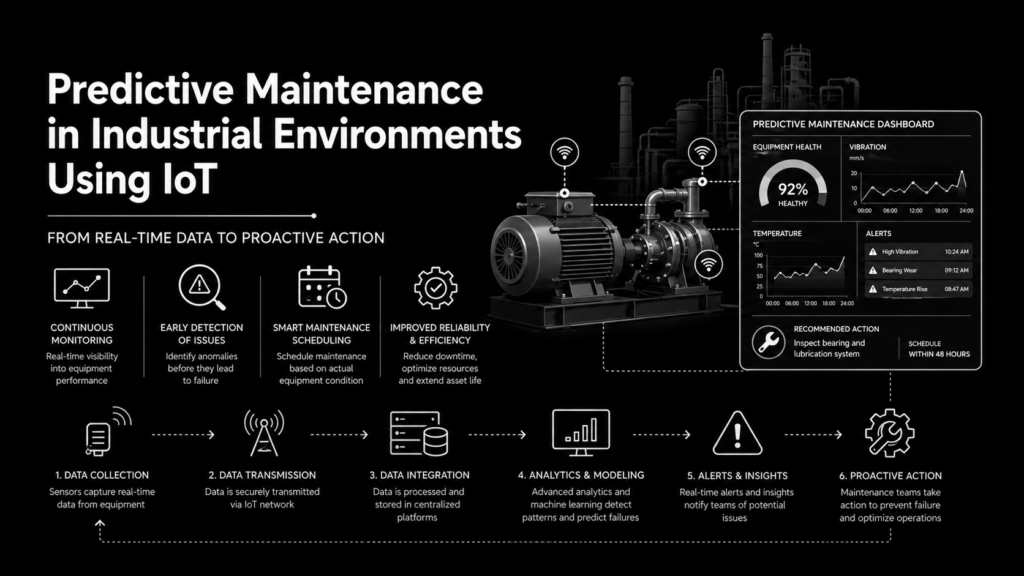
Predictive Maintenance in Industrial Environments Using IoT
Industrial operations rely heavily on equipment performance and system reliability. Traditional maintenance approaches, such as reactive or scheduled maintenance, often result in unexpected downtime or inefficient resource utilization.
Predictive maintenance, powered by IoT solutions and real-time data analytics, enables organizations to monitor equipment continuously and detect potential issues before they lead to failure. This shift allows industrial environments to move from reactive maintenance to proactive operational strategies.
What Is Predictive Maintenance?
Predictive maintenance is a data-driven approach that uses real-time monitoring and analytics to anticipate equipment failures. By analyzing data collected from sensors and connected systems, organizations can identify patterns that indicate wear, inefficiencies, or potential breakdowns.
This approach is supported by advanced data science and analytics, which transform raw operational data into actionable insights.
- Continuous monitoring of equipment performance
- Early detection of anomalies
- Data-driven maintenance scheduling
- Improved operational planning
How IoT Enables Predictive Maintenance
IoT plays a critical role in predictive maintenance by connecting sensors, devices, and systems across industrial environments. These connected systems continuously collect data related to equipment condition, usage, and environmental factors.
Through integrated data engineering platforms, this data is processed and structured to provide meaningful insights for maintenance teams.
- Real-time data collection from sensors
- Continuous monitoring of operational conditions
- Integration across multiple systems
- Centralized data visibility
Reducing Downtime and Improving Reliability
One of the most significant benefits of predictive maintenance is the reduction of unplanned downtime. By identifying potential failures early, organizations can schedule maintenance activities at the most appropriate time without disrupting operations.
With the support of visual analytics platforms, teams can monitor performance trends and respond quickly to emerging issues.
- Minimized unexpected equipment failures
- Improved asset reliability
- Better maintenance planning
- Reduced operational disruptions
Enhancing Efficiency Through Data-Driven Insights
Predictive maintenance not only prevents failures but also enhances overall operational efficiency. By analyzing equipment performance over time, organizations can optimize maintenance schedules and improve resource allocation.
These insights are further strengthened through Industrial Data & AI Intelligence, enabling more informed decision-making across operations.
- Optimized maintenance intervals
- Reduced maintenance costs
- Extended equipment lifespan
- Improved operational performance
Integration with AI and Advanced Analytics
When combined with AI and advanced analytics, predictive maintenance becomes even more effective. AI models can analyze large volumes of data to detect complex patterns and predict failures with greater accuracy.
Leveraging AI-driven solutions, organizations can move toward more intelligent and autonomous maintenance strategies.
- Advanced pattern recognition
- Improved prediction accuracy
- Automated alerts and insights
- Continuous performance optimization
Conclusion
Predictive maintenance is transforming how industrial environments manage equipment and operations. By combining IoT connectivity, data analytics, and AI, organizations can reduce downtime, improve reliability, and optimize performance.
As industrial systems become more connected, predictive maintenance will play an increasingly important role in enabling smarter, more efficient, and more resilient operations.
Disclaimer: This article is provided for informational purposes only. It describes predictive maintenance technologies and operational approaches without representing performance guarantees or specific system outcomes.
FAQ
What is predictive maintenance in industrial environments?
Predictive maintenance is a data-driven approach that uses real-time monitoring and analytics to detect potential equipment failures before they occur, allowing maintenance to be performed proactively.
How does IoT support predictive maintenance?
IoT enables predictive maintenance by connecting sensors and devices that continuously collect data on equipment performance, helping identify patterns and detect early signs of issues.
What are the benefits of predictive maintenance?
Predictive maintenance helps reduce downtime, improve asset reliability, optimize maintenance schedules, and lower overall operational costs.
How is predictive maintenance different from preventive maintenance?
Preventive maintenance is performed on a fixed schedule, while predictive maintenance is based on real-time data and condition monitoring, making it more efficient and targeted.
Can predictive maintenance reduce operational costs?
Yes, by preventing unexpected failures and optimizing maintenance activities, predictive maintenance reduces repair costs, downtime, and unnecessary servicing.
What role does data analytics play in predictive maintenance?
Data analytics processes information collected from sensors to identify trends, detect anomalies, and generate insights that support maintenance decisions.
Is predictive maintenance suitable for all industries?
Predictive maintenance is widely used in industries such as manufacturing, energy, logistics, and facility operations where equipment reliability is critical.
How does AI enhance predictive maintenance?
AI enhances predictive maintenance by analyzing large datasets, identifying complex patterns, and improving the accuracy of failure predictions over time.