
Industrial Ethernet and Network Infrastructure for Smart Factories in Saudi Arabia (2026)
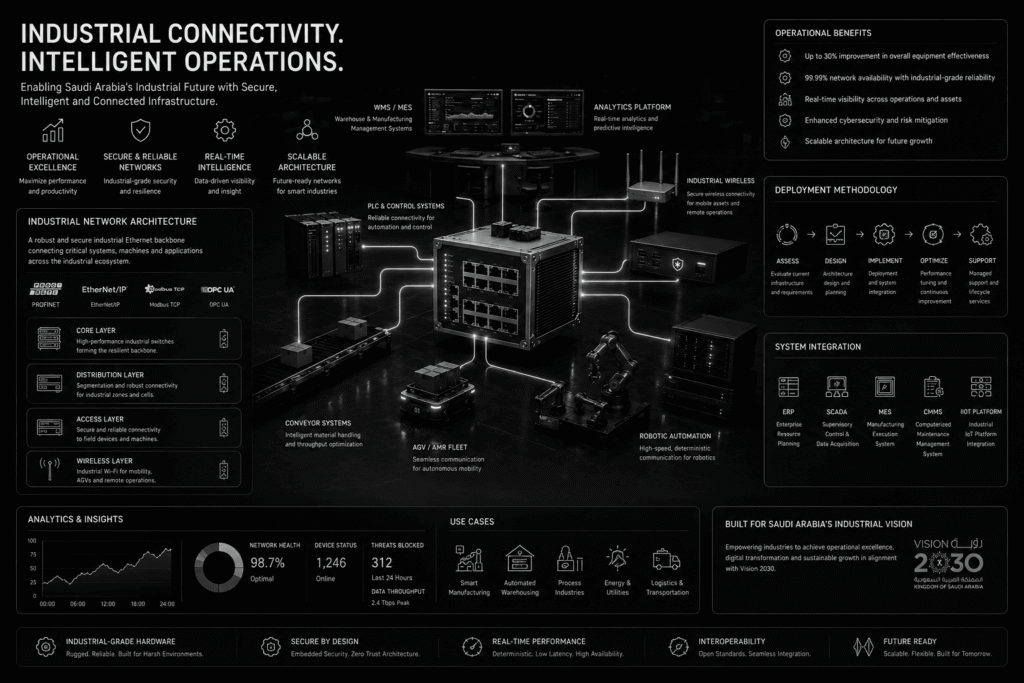
Every automated system in a modern industrial facility, from conveyor controllers and robotic fleets to warehouse management platforms and cybersecurity appliances, depends on network infrastructure to function. Industrial Ethernet provides the communication backbone that connects these systems, enabling real-time data exchange, centralized monitoring, and coordinated equipment operation. Without reliable networking, automation equipment operates in isolation, and the integrated operational intelligence that justifies automation investment cannot be realized.
At Manusphere, industrial networking infrastructure is designed and deployed as a foundational layer within every automation architecture.
Why Industrial Networking Differs from Enterprise IT
Industrial networks operate under constraints that enterprise IT networks rarely encounter. Temperature extremes, dust, vibration, and electromagnetic interference are standard conditions on factory floors and in warehouse environments. Network equipment must be ruggedized for these conditions. Latency requirements are also different. A control loop between a sensor and a PLC may require sub-millisecond response, while enterprise applications tolerate tens of milliseconds without issue. Industrial networking equipment is engineered to deliver deterministic, low-latency performance in physically demanding environments.
Industrial Ethernet Switches
Industrial Ethernet switches form the core of facility network infrastructure. These switches are designed for DIN rail mounting, extended temperature operation, and redundant power inputs. Managed industrial switches provide VLAN segmentation, Quality of Service (QoS) prioritization, and network access control features that are essential for separating control traffic from monitoring data and protecting OT networks from unauthorized access.
In automated warehouse environments, industrial switches connect conveyor control platforms, pick-to-light controllers, robotic fleet servers, and facility management platforms into a unified communication network.
Industrial Gateways and Protocol Translation
Industrial environments typically contain equipment from multiple vendors using different communication protocols. Industrial gateways translate between these protocols, enabling a Modbus device to communicate with an EtherNet/IP controller, or an OPC UA server to exchange data with a legacy serial device. Gateways also serve as secure boundary devices between OT and IT network zones, enforcing protocol filtering and access policies as part of the facility's cybersecurity architecture.
Industrial Wireless Networks
Industrial wireless networks complement wired Ethernet infrastructure in areas where cabling is impractical or where mobile equipment requires connectivity. Autonomous mobile robots, handheld scanners, and mobile workstations all depend on wireless connectivity for real-time communication with central management systems. Industrial-grade wireless access points provide the coverage density, roaming performance, and interference resilience required in environments where consumer-grade Wi-Fi equipment fails.
Network Infrastructure and Data Intelligence
Industrial networks carry the data that feeds automation monitoring platforms and data integration platforms. Equipment status, throughput metrics, energy consumption, fault events, and process data all traverse the industrial network on their way to analytics and visualization systems. Network reliability and bandwidth directly determine whether these platforms receive complete, timely data or operate on incomplete information.
Operational Advantages of Purpose-Built Industrial Networks
- Deterministic, low-latency communication for real-time control applications
- Ruggedized hardware rated for industrial temperature, vibration, and EMI conditions
- Network segmentation supporting OT cybersecurity zone architectures
- Protocol translation enabling multi-vendor equipment interoperability
- Wireless coverage for mobile robots, handheld devices, and flexible workstations
- Scalable architecture that grows with facility expansion
Manusphere's Networking Deployment Approach
Manusphere designs industrial network infrastructure as an integral component of automation architecture projects. Network topology, switch placement, wireless coverage, protocol requirements, and security zone boundaries are defined during the architecture phase and deployed alongside the automation equipment they support. This ensures that networking is not a constraint on automation performance but rather the enabler that connects every system into a coordinated operational whole.
Disclaimer: This article is provided for informational purposes only. It describes industrial networking technologies and Manusphere's integration services without representing performance guarantees or regulatory certifications.