
Industrial System Integration: Building Connected Automation Infrastructure in Saudi Arabia (2026)
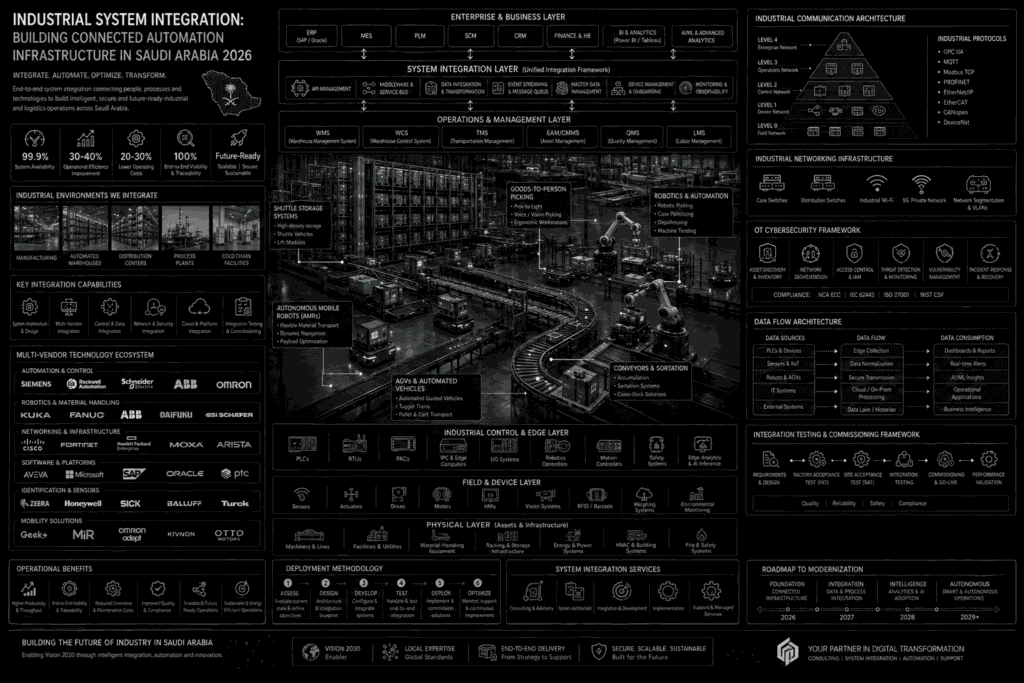
Industrial automation is not a single technology purchase. It is an architecture decision. Conveyor systems, robotic platforms, warehouse management software, industrial networks, and cybersecurity infrastructure must work together as a coordinated system. When these technologies are deployed as disconnected components, facilities experience integration gaps, data silos, communication failures, and operational inefficiencies that undermine the investment case for automation. System integration is the discipline that prevents this outcome.
At Manusphere, system integration services connect every technology layer into a unified automation environment where equipment, software, networks, and security operate as one system.
Why System Integration Is the Critical Success Factor
Individual automation technologies are mature and commercially available. Conveyors, AMRs, WMS platforms, and industrial switches can each be procured from multiple suppliers. The challenge is not acquiring the technology. It is making different technologies from different vendors communicate, coordinate, and perform reliably within a single operational environment. A warehouse management system that cannot exchange data with a conveyor control platform creates manual workarounds. An AMR fleet that cannot receive task assignments from a warehouse control system operates below its potential. System integration eliminates these gaps.
Automation Architecture Design
Automation architecture defines the master plan for how all technology layers will interact within a facility. This includes the physical layout of conveyor and material handling systems, the operational zones for robotic automation, the network topology for industrial networking, the security zone boundaries for OT cybersecurity, and the data flows between digital platforms and physical equipment. Architecture design occurs before equipment procurement, ensuring that every component selected fits within the integrated plan.
Warehouse Modernization
Many Saudi facilities are not greenfield projects. They are existing operations that need to modernize without shutting down. Warehouse modernization projects introduce automation into live operational environments, requiring phased implementation plans that maintain operational continuity while new systems are installed, tested, and commissioned. This is inherently an integration challenge, as new automation equipment must connect to existing infrastructure, legacy systems, and established workflows.
Technology Integration Services
Technology integration services cover the technical execution of connecting disparate systems. This includes interface development between software platforms, protocol translation between equipment from different vendors, data mapping between enterprise systems and automation controllers, and end-to-end testing that validates integrated system performance under operational conditions. Integration engineers work across technology boundaries, understanding both the IT systems that manage orders and inventory and the OT systems that control physical equipment.
The Integration Layer Across the Automation Ecosystem
System integration touches every category within the industrial automation ecosystem. Warehouse automation equipment must coordinate with WMS platforms. AMR fleets must communicate through industrial wireless networks. Data integration platforms must connect operational data to enterprise analytics. Each of these connections is an integration point that must be designed, built, tested, and maintained.
What Effective System Integration Delivers
- Unified automation operation across multi-vendor technology environments
- Seamless data flow between management software and physical equipment
- Reduced manual workarounds and operational gaps between systems
- Faster deployment timelines through pre-validated integration architectures
- Scalable infrastructure that accommodates new technology additions
- Single point of accountability for total system performance
Manusphere's Integration Philosophy
Manusphere operates as a systems integrator. This is not an additional service layered on top of product sales. It is the core of what Manusphere delivers. We do not manufacture automation equipment. We design the architecture that determines how equipment from global technology partners will work together, deploy that equipment within a unified operational framework, and take responsibility for ensuring that the integrated system performs as designed. For organizations in Saudi Arabia planning automation investments, the integrator is the partner that determines whether individual technology purchases become a connected operational system or a collection of expensive, disconnected equipment.
Disclaimer: This article is provided for informational purposes only. It describes system integration services and Manusphere's integration approach without representing performance guarantees or regulatory certifications.