
Automated Guided Vehicles (AGV) for Industrial Material Handling in Saudi Arabia (2026)
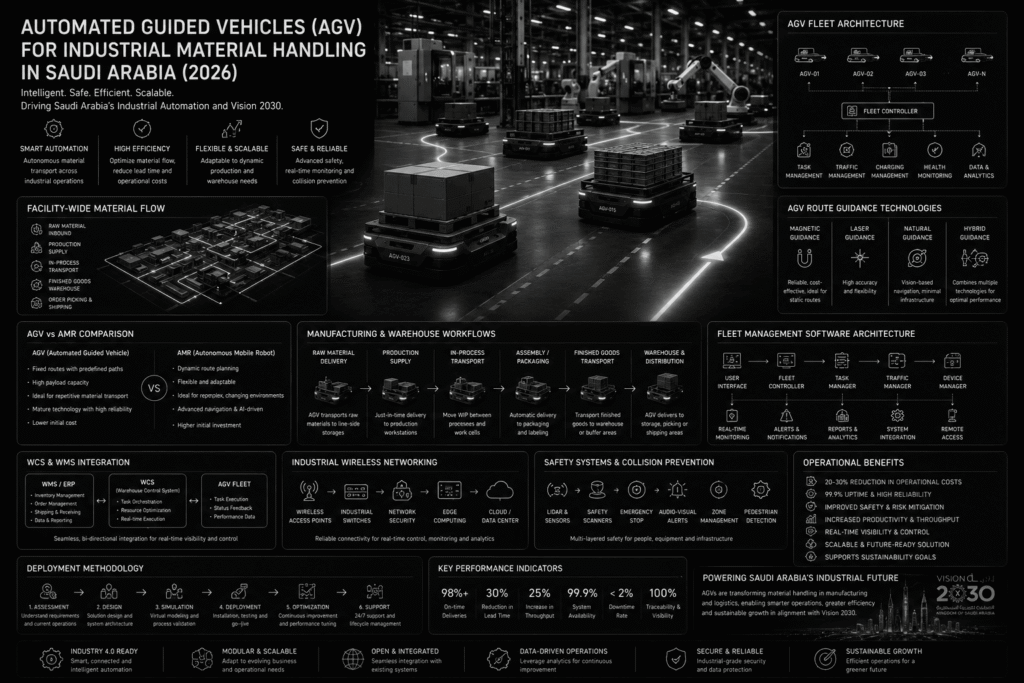
Automated guided vehicles have been a proven material handling technology in industrial environments for decades. In Saudi Arabia's manufacturing plants, logistics facilities, and industrial compounds, AGVs automate the repetitive transport of heavy loads along defined routes, replacing manual forklift operations with consistent, programmable material movement that operates continuously across shifts.
At Manusphere, automated guided vehicle deployments are integrated within broader robotic automation architectures that combine AGVs with complementary technologies to create complete material transport systems.
How AGVs Operate
Automated guided vehicles follow predefined paths through a facility using guidance technologies such as magnetic tape, floor-embedded markers, laser reflectors, or natural feature navigation. The vehicle receives transport assignments from a central control system, travels to the pickup location, loads material (automatically or with operator assistance depending on the configuration), transports it along the designated route, and delivers it to the destination. AGVs are available in multiple form factors including tuggers, unit load carriers, pallet trucks, and heavy-load transporters, each designed for specific material types and load profiles.
AGV Applications in Saudi Industrial Operations
Manufacturing plants use AGVs to transport raw materials from receiving docks to production lines, move work-in-progress between processing stations, and deliver finished goods to packaging or storage areas. In warehouse environments, AGVs handle pallet transport between dock doors and storage locations, connecting inbound receiving to deep storage zones. In automotive, food processing, and heavy industrial settings, AGVs manage loads that exceed what manual handling can safely accomplish.
AGVs complement fixed conveyor infrastructure by handling transport segments that require floor-level flexibility or that connect areas where conveyor installation is impractical.
AGV vs. AMR: Choosing the Right Technology
AGVs and autonomous mobile robots (AMR) both automate material transport but serve different operational profiles. AGVs excel in environments with stable, high-volume transport routes where path predictability and heavy load capacity are priorities. AMRs are better suited to dynamic environments where routes change frequently and loads are lighter. Many facilities deploy both technologies, using AGVs for heavy, repetitive transport corridors and AMRs for flexible, lighter-load tasks.
Integration with Facility Systems
AGV fleets connect to facility automation through central fleet management software that interfaces with warehouse control systems (WCS) and warehouse management systems (WMS). These integrations ensure that AGV transport tasks align with production schedules, order priorities, and equipment availability across the facility. Industrial wireless networks provide the communication infrastructure for real-time vehicle tracking and task assignment.
Safety Considerations
AGVs operate in shared environments alongside human workers and other equipment. Safety features include obstacle detection sensors, emergency stop systems, audible and visual warning signals, and speed reduction in pedestrian zones. AGV route design considers traffic patterns, intersection management, and separation between vehicle and pedestrian paths. These safety measures integrate with broader facility safety infrastructure, including collision prevention systems deployed across the site.
Operational Advantages of AGV Deployment
- Consistent, predictable material transport along defined routes
- Heavy load capacity exceeding what manual handling can safely achieve
- Continuous operation across shifts without fatigue-related performance degradation
- Reduced forklift-related safety incidents in facility transport corridors
- Programmable routing that adapts to production schedule changes
- Integration with warehouse and manufacturing execution systems
Manusphere's AGV Integration Approach
Manusphere selects, deploys, and integrates AGV systems as part of comprehensive industrial automation ecosystems. AGV technology selection, route design, fleet sizing, and system integration are managed within the broader automation architecture framework, ensuring that AGVs operate as coordinated elements within the facility's complete material handling infrastructure.
Disclaimer: This article is provided for informational purposes only. It describes automated guided vehicle technologies and Manusphere's integration services without representing performance guarantees or regulatory certifications.