
Autonomous Mobile Robots (AMR) in Warehouse and Logistics Operations in Saudi Arabia (2026)
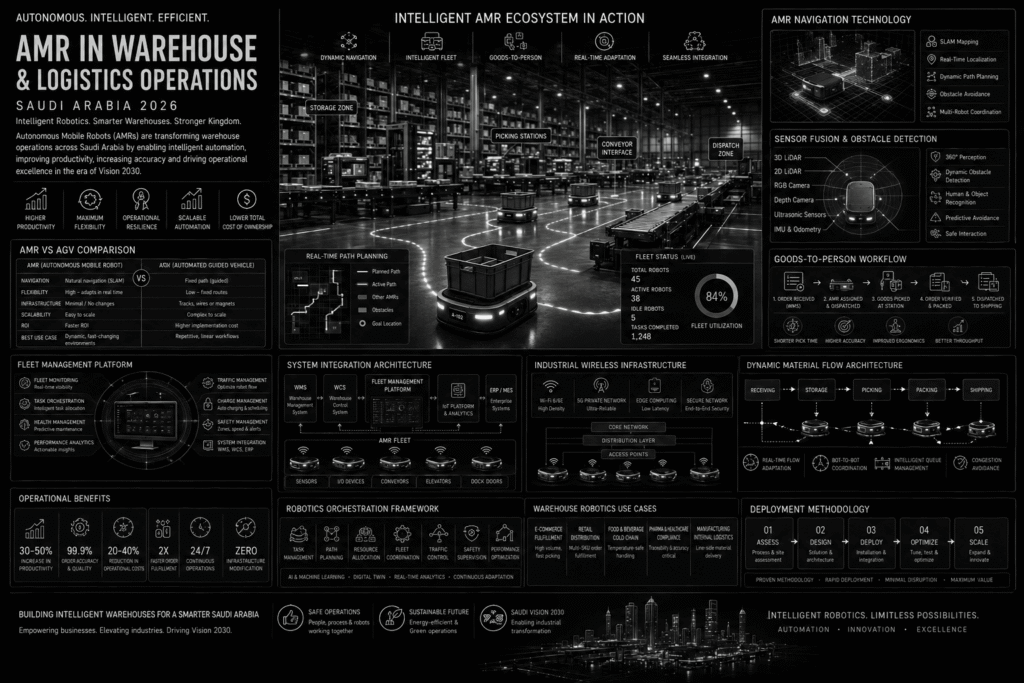
Warehouse and logistics operations across Saudi Arabia are adopting autonomous mobile robots to address increasing throughput demands without proportional increases in floor space or manual labor. Unlike fixed-path conveyor systems, AMRs navigate dynamically through facility environments, transporting goods between storage locations, picking stations, and processing zones without requiring physical guide infrastructure.
At Manusphere, autonomous mobile robot deployments are integrated into broader automation architectures that combine robotics with conveyor systems, digital platforms, and industrial networking infrastructure.
How AMRs Operate in Industrial Environments
Autonomous mobile robots use onboard sensors and navigation algorithms to move through warehouse and industrial environments without predefined physical tracks. The robots map their operating environment, detect obstacles, and calculate optimal paths to their assigned destinations in real time. This dynamic navigation allows AMRs to operate safely alongside human workers and adapt to changing facility layouts without infrastructure modifications.
AMRs are typically deployed in fleets managed by central fleet management software that assigns tasks, coordinates traffic, manages charging cycles, and balances workload across available robots.
AMR vs. AGV: Understanding the Difference
Autonomous mobile robots and automated guided vehicles (AGV) both automate material transport, but they operate on different principles. AGVs follow fixed paths defined by magnetic tape, floor markers, or embedded wires. AMRs navigate freely using sensor-based mapping and path planning. This distinction determines where each technology fits best. AGVs are well-suited to repetitive, high-volume transport along fixed routes. AMRs are better suited to environments where routes change frequently, floor space is shared with people, or facility layouts evolve over time.
Many facilities deploy both technologies in complementary roles within the same robotic automation architecture.
Key AMR Applications in Saudi Logistics
In warehouse environments, AMRs are commonly deployed for goods-to-person picking, where robots transport mobile shelving units to stationary pick stations, eliminating the need for operators to walk through the warehouse. In manufacturing settings, AMRs handle material transport between production lines, quality inspection stations, and staging areas. In large distribution centers, AMRs complement conveyor systems by covering transport segments that are impractical or uneconomical to serve with fixed conveyor infrastructure.
Integration with Facility Automation Systems
AMRs achieve their full operational impact when connected to facility management and control systems. Warehouse control systems (WCS) coordinate robot task assignments with conveyor activity and picking operations. Warehouse management systems (WMS) provide order and inventory data that drives robot dispatching logic. Reliable industrial wireless networks are essential for maintaining continuous communication between the fleet management platform and individual robots across the facility.
Operational Advantages of AMR Deployment
- Dynamic navigation that adapts to changing facility layouts without infrastructure changes
- Safe operation alongside human workers through real-time obstacle detection
- Scalable fleet size that adjusts to seasonal or volume-driven demand changes
- Reduced operator walking distance through goods-to-person workflows
- Lower deployment complexity compared to fixed-path systems
- Continuous operation through automated charging management
Manusphere's AMR Integration Services
Manusphere deploys AMR fleets as part of integrated industrial automation ecosystems. Each deployment includes site assessment, technology selection from our vendor network, integration with existing automation equipment and software platforms, and commissioning. The objective is to ensure that AMR fleets operate as coordinated elements within the facility's unified automation architecture, not as standalone islands of technology.
Disclaimer: This article is provided for informational purposes only. It describes autonomous mobile robot technologies and Manusphere's integration services without representing performance guarantees or regulatory certifications.