
Warehouse Automation Solutions for Industrial and Logistics Operations in Saudi Arabia (2026)
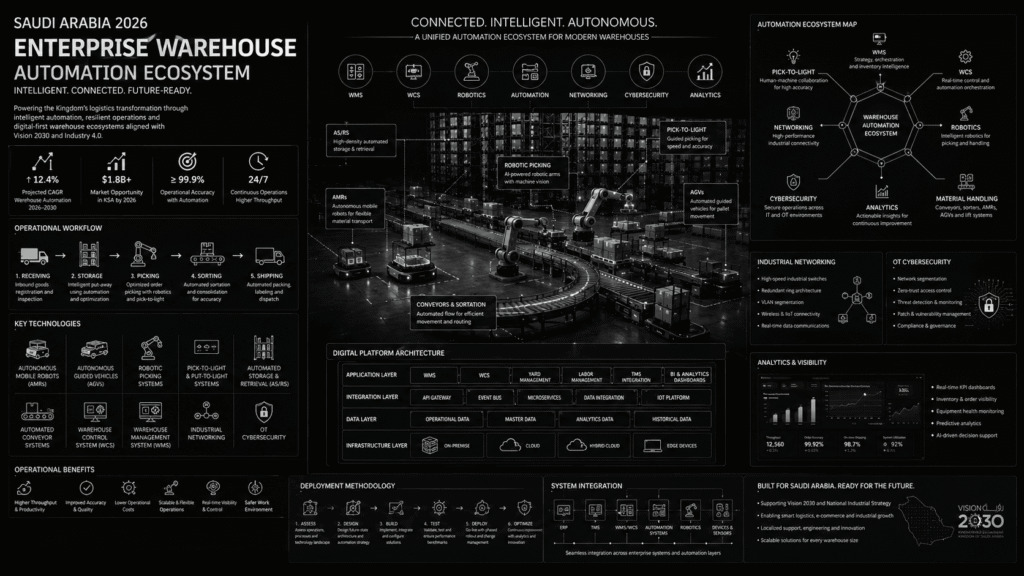
Saudi Arabia's logistics and warehousing sector is undergoing a structural shift. Facilities that once relied on manual processes for picking, sorting, and inventory movement are now deploying integrated automation systems to increase throughput, reduce operational errors, and support higher order volumes. For operations leaders managing large distribution centers, manufacturing warehouses, or third-party logistics facilities, automation is no longer a future consideration. It is an operational requirement.
At Manusphere, we design and deploy warehouse and logistics automation infrastructure that integrates material handling, robotics, control systems, and digital platforms into unified operational environments.
Why Warehouse Automation Is Accelerating in Saudi Arabia
Several forces are driving adoption. E-commerce fulfillment volumes continue to grow, placing pressure on warehouse throughput and accuracy. Labor availability in repetitive logistics roles remains constrained. Large-scale industrial and logistics zones are expanding across Riyadh, Jeddah, and Dammam, and the facilities within them require automation from day one to meet performance targets.
Warehouse automation addresses these pressures by replacing manual material movement with engineered systems that operate at consistent speed and accuracy. The result is higher throughput per square meter, fewer picking errors, and reduced dependency on manual labor for repetitive tasks.
Core Technologies in Modern Warehouse Automation
A fully automated warehouse environment typically combines several technology layers. Conveyor and material handling systems move products between zones. Autonomous mobile robots (AMR) and automated guided vehicles (AGV) transport goods across floor space without fixed infrastructure. Pick-to-light systems direct operators to the correct bin location, reducing search time and pick errors. Warehouse control systems (WCS) coordinate equipment activity across the facility in real time.
Each of these technologies delivers value independently, but their combined deployment creates a system where material flows continuously from receiving to dispatch with minimal manual intervention.
The Role of Conveyor Infrastructure
Conveyors remain the backbone of warehouse automation. Motor-driven roller (MDR) technology provides energy-efficient, zone-controlled movement that activates only when product is present. Conveyor automation platforms manage routing, merging, diverting, and accumulation across complex facility layouts. These systems connect receiving docks, storage zones, picking stations, and shipping lanes into a continuous flow.
Robotics in Warehouse Operations
Robotic systems are expanding the scope of warehouse automation beyond fixed conveyor paths. Robotic automation platforms enable goods-to-person picking, autonomous pallet transport, and high-density storage retrieval through shuttle storage systems. These technologies allow facilities to scale throughput without proportional increases in floor space or labor headcount.
Digital Platforms and Data Integration
Automation hardware requires intelligent software to operate effectively. Warehouse management systems (WMS) manage inventory, order allocation, and task sequencing. Automation monitoring platforms provide real-time visibility into equipment status, throughput metrics, and fault conditions. Data integration platforms connect warehouse systems to enterprise resource planning (ERP), transportation management, and analytics environments.
Network and Cybersecurity Infrastructure
Automated warehouses generate continuous data traffic between controllers, sensors, robots, and management platforms. Reliable industrial networking infrastructure is essential for maintaining real-time communication across these systems. Equally critical is OT cybersecurity, which protects operational technology networks from unauthorized access and ensures that automation systems remain available and uncompromised.
Benefits of Integrated Warehouse Automation
- Higher order throughput with consistent accuracy across shifts
- Reduced manual handling and associated error rates
- Improved space utilization through high-density storage and compact material flow paths
- Real-time operational visibility for facility management
- Scalable infrastructure that adapts to seasonal volume fluctuations
- Lower operational cost per unit handled over time
Manusphere's Integration Approach
Manusphere operates as a systems integrator, not a product manufacturer. We assess facility requirements, select the appropriate combination of automation technologies from our global vendor ecosystem, and deploy integrated solutions where conveyors, robotics, control systems, networking, cybersecurity, and digital platforms operate as one connected environment. Our system integration services ensure that each technology layer communicates and performs within a unified architecture designed for the specific operational profile of the facility.
For organizations evaluating warehouse automation in Saudi Arabia, the decision is not which single technology to adopt. It is how to architect a complete system where every component contributes to a measurable improvement in operational performance.
Disclaimer: This article is provided for informational purposes only. It describes warehouse automation technologies and Manusphere's integration services without representing performance guarantees or regulatory certifications.